
Fotona laser
Laser Hair Removal for Different Skin Tones
How skin tone and hair colour affect laser hair removal, what Fitzpatrick skin types mean, why Nd:YAG suits darker skin, and the limits for light or grey hair.
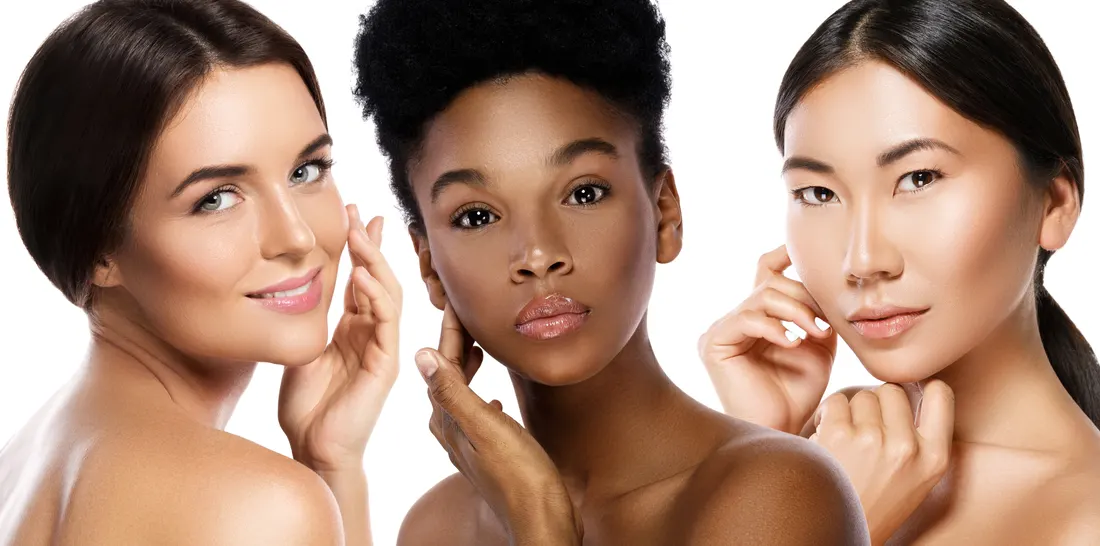
Laser hair removal can be done safely on a wide range of skin tones, including darker skin, as long as the wavelength and settings are chosen for that skin. Longer wavelengths such as Nd:YAG (1064 nm) are generally the safer choice for medium to dark skin. Hair colour matters just as much: laser works poorly on blond, grey, white and most red hair, whatever the skin tone.
The basic challenge: two sources of pigment
Hair removal lasers aim at melanin, the pigment in the hair. The problem is that skin contains melanin too. When light enters the skin, the pigment in the surface layer and the pigment in the hair follicle both absorb some of it.
The more pigment there is in the skin, the more energy the surface absorbs. If too much is absorbed there, the result can be a burn, a blister or a change in skin colour. So the goal is to deliver enough energy to the follicle while keeping the skin's share low. That balance is what differs from one skin tone to another.
Understanding Fitzpatrick skin types
Clinicians often describe skin using the Fitzpatrick scale, which groups skin by how it reacts to sun:
- Type I: very fair, always burns, never tans
- Type II: fair, usually burns, tans with difficulty
- Type III: light to medium, sometimes burns, tans gradually
- Type IV: olive or light brown, rarely burns, tans easily
- Type V: brown, very rarely burns
- Type VI: deeply pigmented brown to black, almost never burns
The scale is a rough guide, not a perfect measure. It was originally developed to predict sunburn, and it does not capture every skin tone well. Your clinician will also look at your current tan, your ethnic background, how your skin has healed in the past, and whether it tends to darken after irritation.
Why Nd:YAG is often used for darker skin
Different hair removal lasers use different wavelengths. Shorter wavelengths, such as alexandrite (755 nm), are absorbed strongly by melanin. That makes them efficient on fair skin with dark hair, but riskier for darker skin because the surface absorbs more of the energy.
The Nd:YAG wavelength at 1064 nm is absorbed less by melanin overall. It passes through the surface pigment more easily and reaches the deeper follicle. This lowers the risk to the skin in Fitzpatrick types IV to VI, which is why it is widely considered an appropriate option for darker skin. For more on how the two wavelengths in a Fotona device differ, see what the Fotona laser is and how it works.
The trade-off is that because Nd:YAG is absorbed less by melanin, it can be somewhat less efficient on finer or lighter hair. People with darker skin may need careful settings and sometimes extra sessions. Treatment can also feel more intense with this wavelength, so cooling matters.
Hair colour: the other half of the equation
Hair colour can be a bigger limit than skin tone. Laser needs pigment in the hair to absorb the light.
- Dark brown and black hair generally responds best.
- Light brown hair may respond, but more slowly.
- Red hair contains a different type of melanin that absorbs laser light poorly, so results are often limited.
- Blond, grey and white hair usually does not respond in a useful way.
If your hair is light or grey, it is better to hear that honestly before you start. Electrolysis, which treats each follicle individually with an electric current, works regardless of hair colour and may be a better fit for some people.
Extra precautions for darker or tanned skin
For anyone whose skin has more pigment, either naturally or from a tan, a careful approach includes:
- A test spot, checked after a few days or more, before treating a larger area
- Starting with conservative energy and increasing gradually
- Good skin cooling during treatment
- Strict sun avoidance and sunscreen before and after sessions
- No self-tanner on the treatment area
A tan temporarily raises the skin's pigment, so even fair skin behaves like a darker type when tanned. That is one reason many people prefer to plan treatment during the cooler months. Our guide to preparing for laser hair removal covers sun and product precautions.
Who should not have it, or should wait
Regardless of skin tone, treatment is usually postponed if you are pregnant, have an active infection, rash or cold sore in the area, have a recent tan or sunburn, or have taken isotretinoin recently or use medicines that increase light sensitivity. People with a history of keloids or significant darkening after skin injury need a frank discussion about risk first. New, rapidly increasing hair growth should be checked by your family doctor to rule out a hormonal cause. Do not stop prescribed medication on your own.
Risks that differ by skin tone
Redness and bumps around follicles are common for everyone and usually settle within a day or two. In darker skin, the main concern is pigment change: dark patches (post-inflammatory hyperpigmentation) or, less commonly, light patches (hypopigmentation). These usually fade over weeks to months, but sometimes persist longer. Burns, blistering and scarring are less common but possible. In fair skin, burns are more often linked to a tan or overly aggressive settings.
Frequently asked questions
Is laser hair removal unsafe for Black or South Asian skin?
No, it is not inherently unsafe. With an appropriate wavelength, conservative settings and a test spot, it can be done carefully on deeply pigmented skin. The risk of pigment change is higher, so the approach needs to be cautious.
I have fair skin and red hair. Will it work?
Results are often disappointing for red hair. A consultation can help you decide whether a trial is worthwhile or whether another method makes more sense.
Does my skin type change over the year?
Your underlying type does not, but a summer tan makes your skin behave as if it were darker. Settings may need to change, or treatment may be paused, depending on the season.
If you would like your skin and hair assessed, HealthPark Medical Aesthetics can review your history, check how your skin responds with a test spot, and tell you plainly whether laser is likely to suit you.
Keep reading
Fotona laser
Skincare Before and After Laser: Prep and Recovery
Which skincare products to pause before laser, priming pigment-prone skin, barrier-repair care during recovery, and when it is usually safe to restart actives.
Read article
Fotona laser
Small Bumps Around the Eyes: Syringomas and Milia
How to tell syringomas from milia, why these harmless bumps around the eyes can recur, careful Er:YAG laser treatment, gentle alternatives and main risks.
Read article
Fotona laser
Underarm Laser Hair Removal: What to Know
Underarm laser hair removal explained: shaving and deodorant before treatment, effects on ingrown hairs and darkening, sweating myths and typical sessions.
Read article